Iran and Yemen on the Table of an "Unannounced" Meeting of Trump's Senior Advisors
Senior national security officials in President Donald Trump's administration met for hours at Camp David on Friday to discuss the next steps in the Iran war and the situation in Yemen, as the United States is mobilizing its forces in the Middle East amid stalled negotiations with Tehran.
Ofoq News
·5 minutes read
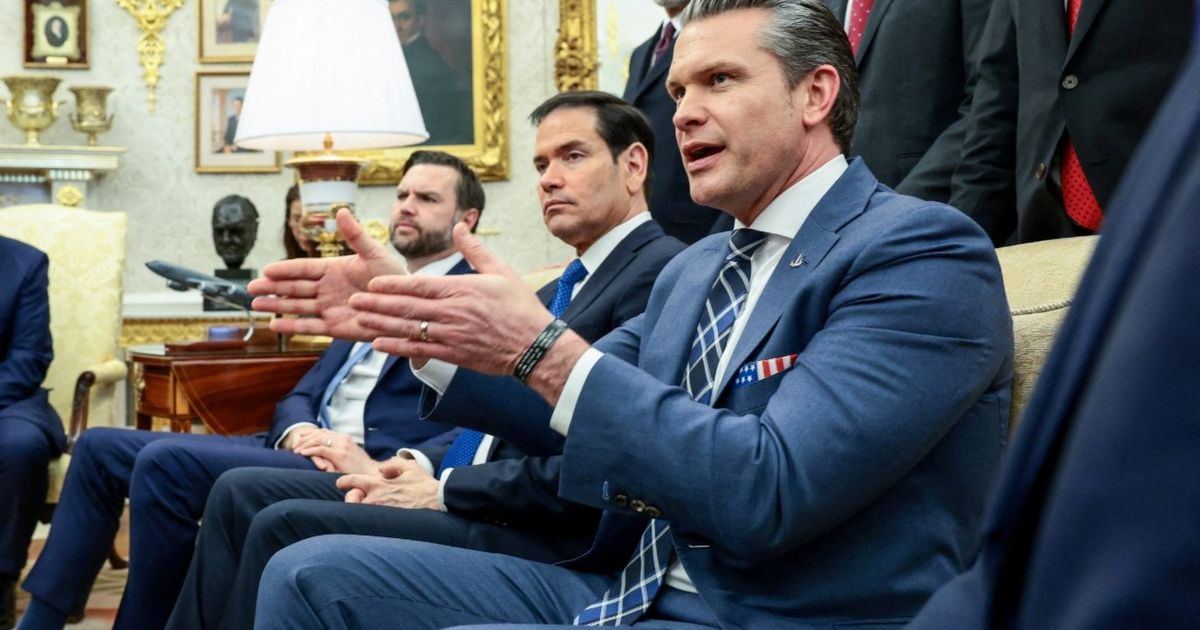
Senior national security officials in President Donald Trump's administration met for hours at Camp David on Friday to discuss the next steps in the war with Iran and the situation in Yemen, as the United States is mobilizing its forces in the Middle East amid stalled negotiations with Tehran.
Three American officials told Axios that the Trump administration did not announce the meeting and described it as "unusual."
The last similar meeting held at Camp David was in June 2025, just days before Israel began its 12-day war with Iran.
Vice President JD Vance chaired the meeting, according to the officials.
Also participating in the meeting were Secretary of State Marco Rubio, Secretary of Defense Pete Hegseth, Special Envoy Steve Witkoff, CIA Director John Ratcliffe, and Chairman of the Joint Chiefs of Staff General Dan Keen.
One of the officials said, referring to the situation in the Middle East News: "Decisions have been made, or at least matters have been discussed in depth."
The meeting comes at a time when negotiations have reached a deadlock, while Trump is considering resuming large-scale military operations in Iran.
During a campaign rally in Alabama on Friday evening, Trump stated that the Iran war will end soon, either through an agreement or military action. He added: "It will end very soon, probably right after the elections, but once it ends, oil prices will collapse."
While his advisers were meeting at Camp David, Trump was asked on Friday about his next step regarding Iran. He replied: "If I told you, you would have a big story. But you will see. Things are going very well. Iran is not doing well at all."
Trump considered that "Iran's military capabilities and leadership have been completely destroyed," pointing out that Iran possessing a nuclear weapon is "unacceptable and non-negotiable," while he said he "does not know who to deal with in Iran."
Trump said in an interview with Time magazine published on Thursday that he might resume strikes on Iran after the midterm elections if no agreement is reached.
For his part, Iranian Supreme National Security Council Secretary Mohsen Rezaei mocked Trump's statements on Friday, describing him in a post on the platform X as "the worst president in the history of the United States."
Rezaei wrote: "You can win every day in your imagination, but reality is made by Iran, with its people, soldiers, and missiles."
As negotiations falter, the U.S. military has sent nearly 10,000 troops aboard a group of ships to the horizon of the Middle East.
These reinforcements would raise the U.S. naval presence in the region to an unusually high level, with more than 20,000 sailors and Marines and hundreds of aircraft.
The aircraft carrier "Theodore Roosevelt" left a port in San Diego on Sunday, while the amphibious readiness group "Makin Island," which includes three amphibious ships carrying elements of the 13th Marine Expeditionary Unit, departed on Monday, according to the Wall Street Journal.
Currently in the region are the aircraft carriers "George W. Bush" and "George Washington," along with the amphibious readiness group "USS Boxer."
Despite Trump's public rejection of the Iranian proposal, mediators continue to work with Iran and the United States in an effort to reach an agreement that ends the fighting and opens the Strait of Hormuz.
U.S. President Donald Trump had rejected a proposal made by Iran during meetings on the sidelines of the United Nations General Assembly in New York, which would have reopened the Strait of Hormuz, the vital waterway through which about one-fifth of the world's oil supply typically passes, and resumed talks on the Iranian nuclear program in exchange for the U.S. lifting its blockade on Iranian ports.
The option of economic sanctions remains ongoing, as the United States expanded its pressure on Iran on Thursday with sanctions targeting companies in the automotive, railway, heavy equipment, and metals sectors, in addition to suppliers and financial networks outside the country, as part of the "economic isolation" process aimed at reducing Tehran's revenues and limiting its circumvention of sanctions.
The U.S. Treasury Department announced the measures at a time when President Donald Trump's administration is expanding the scope of sanctions from the oil, finance, and aviation sectors to other industrial and commercial activities.
U.S. Treasury Secretary Steven Mnuchin announced on August 24 the launch of the "Economic Isolation" initiative, which the department described as a broad campaign aimed at isolating Tehran from revenue sources and financial channels and networks, as well as intermediaries used by Iran and entities linked to the Revolutionary Guard to transfer funds and evade sanctions, while expanding the risks of secondary sanctions on parties that continue to engage with it.
Due to the sanctions and maritime blockade, Iran did not load any crude oil onto tankers during September, the latest indication of the impact of the U.S. blockade on Tehran's ability to access energy markets.
Crude oil loading dropped to zero, compared to about 250,000 barrels per day in August, according to preliminary estimates tracking tankers compiled by Bloomberg.
Shipping data firms "Kpler" and "Fortexa" also reported no shipments of Iranian crude were loaded during the past month.
This decline indicates that Iran has become less capable or willing to withstand the American blockade imposed on its ports, which makes it more difficult for Tehran to continue selling oil to China, a major source of revenue at a time when Washington is seeking to isolate the Iranian economy.
Source: Ofoq News
Suggested
Read also
 Politics
Tripartite Meeting Between Egypt, Chad, and Libya Discusses Security in the Sahel and Sahara Region
 Politics
United States.. Woman Arrested on Suspicion of "Espionage for China"
 Politics