After 3 Years of Tracking the Signal... Antenna Reveals Cohen's Apartment and Encryption Devices
The Syrian officer Said Jawish and the personnel in the 'Signal 134' unit of the army, when they intercepted one of the telegrams in 1962, did not have the name of the man they were looking for. They had a radio frequency, a date for transmission, and a code they assigned to the unknown signal owner to distinguish his messages from others. They kept what they intercepted and sent copies to those working on the code and location identification.
Ofoq News
·10 minutes read
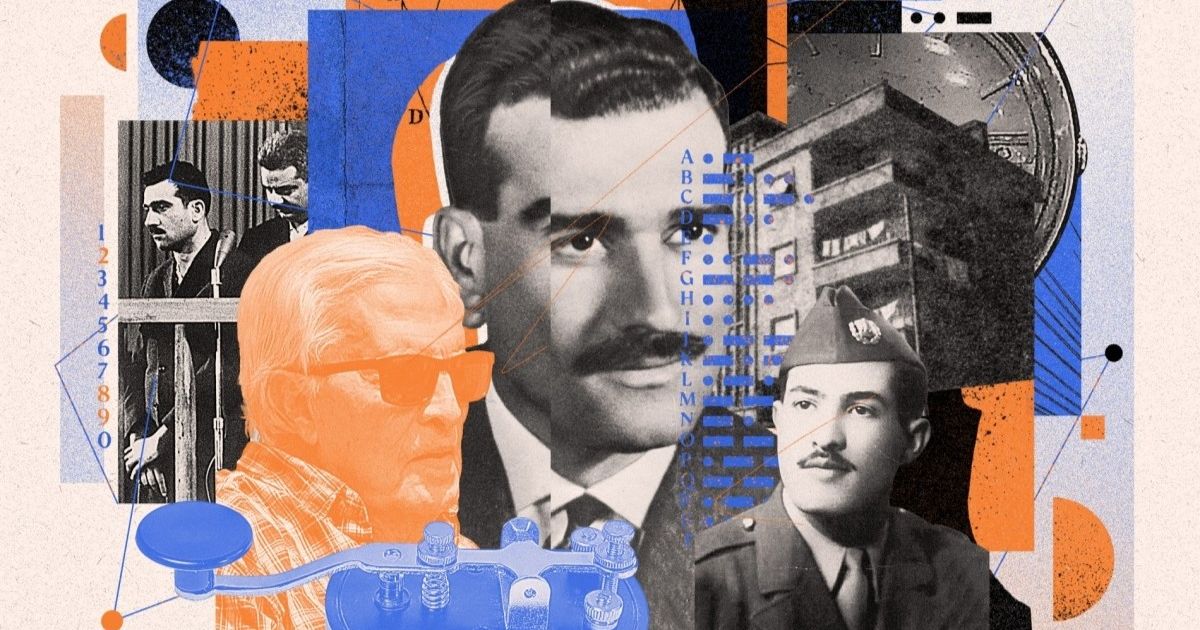
The Syrian officer Saeed Jawish and the personnel at the "Signal 134" unit in the army, when they intercepted one of the messages in 1962, did not have the name of the man they were looking for. They had a radio frequency, a date for the transmission, and a code they assigned to the unknown signal owner to distinguish his messages from others. They kept what they intercepted and sent copies to those working on the code and location identification. Saeed Jawish says that the signal belonged to Eli Cohen, but the team did not know that until years later.
In this episode of the lengthy dialogue with the person who uncovered the Israeli spy Eli Cohen, Jawish reconstructs the path from the signal to the address. According to his account, the location of the broadcast began in a relatively wide area in Damascus, then the circle narrowed to the vicinity of Abu Rummaneh in Damascus, reaching a building where the team studied its residents. Identifying the source was not straightforward; the available devices, as he explains, provided an approximate range and did not indicate an apartment or room. Therefore, the personnel with him resorted to comparing the communications with the movements of people living in the building.
The suspicion initially fell on a pilot working for the Syrian airline. Jawish says he obtained his travel schedule and compared his days of absence with the broadcast dates, which led him and his colleagues to search his home. They entered under the pretext of looking for drugs, searched other apartments, and then left without finding any device. This was followed by complaints that reached the leadership and a reprimand for the unit commander. For the latter, as Jawish recalls, the file was considered closed.
Jawish was not convinced by the outcome. He returned to the building and went up to its roof, where a different antenna caught his attention, in his opinion, from the other antennas. He traced its wire to an apartment on the top floor and read one of his men the name written on its door: Kamel Amin Thabet. The name remained ordinary in their eyes until they returned at a known broadcast time. At that point, Jawish cut off the electricity to the apartment three times, and he says that the effect of the cut was evident in the signal recording. For him, this was the evidence that confirmed the location of the transmission.
The narrative then reaches the moment of the raid. Jawish recalls the number of men who were with him, the weapons they carried, the room where they found Cohen, and the other almost empty rooms. He also describes his search for the transmission device, the small key he found, and then the second device that he says Cohen revealed its location. The code of the messages, which had eluded them for years, was present in his mind throughout the search.
These details are published as narrated by Jawish. It also includes a previous failure to reach the apartment, an objection from the leadership, and a return to the same site with a different approach. This is how the man, who attributes to his unit the discovery of Cohen, recounts that the arrest operation did not begin with a name or a picture, but with a signal whose owners remained unknown for three years. Here is the text of the second episode of the dialogue that took place in his apartment in Damascus:
- There were signals we were following, including the signal of Eli Cohen. We were tracking it gradually.
- We intercepted the first telegram he sent in 1962, but we did not know who he was or where he was sending it from. When we intercepted a signal, we recorded the frequency and date and assigned the sender a number or code. We did not know the person, but we had a code for him.
We continued to use the monitors until the search focused on a building, so we conducted a study about its residents. The basement was inhabited by a foreign officer in the 'International Monitoring Authority.'
Cohen was among these individuals. The signal was intercepted by Mustafa Wahbi al-Kayyali, from Idlib. Mustafa would intercept the telegrams, and whenever he received a telegram, he would place it in its file. We did not know its meaning. A copy was sent to the code department, which could not decipher it, and a copy was sent to the monitoring department to determine the location.
We remained in this situation from early 1962 until 1965, when we narrowed down the location in Damascus.
* You narrowed down the transmission site in Damascus? Tell us the story...
- We gradually narrowed it down in Damascus, then to a triangle located, let's say, south of the Abu Rummaneh neighborhood, between Abu Rummaneh and the Aviation Authority. The Russian observers did not pinpoint the location accurately; they identified an area extending one or two kilometers, but they did not specify a house or a room. They identified this triangle for us, so we began studying the residents in it, from the well-known Star Square to near the Meridian Hotel, and we continued until we narrowed down the location to a building.
- Yes, we continued to use the observers until the search focused on a building, so we conducted a study on its residents. The basement was occupied by a foreign officer in the "International Monitoring Authority."
- That's correct, he was affiliated with the ceasefire. On the ground floor, there was a pilot from the Syrian airline, of Greek origin. The apartments in the building were small. On the first floor, there was a diplomat from the Turkish embassy. Among the residents were elderly Damascene ladies, unmarried and working in sewing, so we excluded them.
I went to the airline and obtained the pilots' travel schedule for the previous year. We compared it with the communication timings and found that communication was absent on most days when the pilot was traveling, and appeared on the days he was in Damascus. We presented the study to the unit leader who said, "By God, the pilot."
- We had to enter the pilot's house. We went to the criminal security and obtained criminal security and "Interpol" cards, on the basis that we were searching for drugs, so as not to reveal our main mission. On the designated day, we went and knocked on the door. An elderly man, elegantly dressed, opened for us. He seemed to be Greek. He was the pilot's father, and in his time, he was a general before he retired.
We entered and told him that we were from the police. We asked about the pilot, who was still in bed; it was eight in the morning. The pilot said, "I speak Arabic, and I am a pilot in Syrian Airlines." We told him that our information indicated that they were bringing him hashish from Lebanon and smuggling it to Europe. We gave him a reason that seemed acceptable, considering Syria is a transit country. He said, "I do not work with drugs." We told him that informing us of their location would lessen his punishment. He said, "Never, search me."
It was a Friday in the month of Ramadan... We stood a few steps from its door and waited for the transmission. When it started, I cut the power from the external circuit breaker three times, and the outages appeared in the recording. At that point, we confirmed that the broadcast was coming from this house.
We searched the house inch by inch, but found nothing indicating the presence of a communication device. We apologized and left, but he was angry because we had searched him and physically searched his father and wife, and he said he would file a complaint.
We stood outside, confused, then said: since we are here, let's enter the other apartments. We went down to the foreign officer's house and knocked on the door. We said we were from the police, and he said he could not allow us to enter and that we had to refer to the Syrian officer responsible for contacting him. We entered and searched, but found nothing. Then we searched the Turkish diplomat's house and found nothing as well. We returned to the unit, dragging our tails in disappointment.
- The dates are recorded, but I can't recall the exact date now. After two days, protests reached the army's General Staff. The head of the intelligence department, Ahmad Suedani, summoned the unit commander and reprimanded him severely. He said to him: 'Do you want cars? Just say so. Do you want things? Just say so. But do not infringe on the people.'
The unit commander summoned me after he came out. His face was pale and red with anger. He said that I had put him in an embarrassing position after I informed him about the presence of a spy. I confirmed to him that there was indeed a spy, and he ended our conversation with the word 'get out.' He was my student and respected me a lot, and I was the main driver of the work. I was very hurt by that meeting, and the matter ended for him.
- An idea struck me to inspect the antennas in the area where we searched the houses. I took some personnel with me and we went up to the roof of the building. I looked closely and found an antenna that was different from all the other antennas: a systematic installation done by an expert, not just a wire stretched to operate a radio, as people used to do before. There was a coaxial cable that descended to an apartment on the fourth floor, the top floor of the building.
I had several personnel with me, including Sergeant Fawaz. I asked him to go to the door where the black cable enters and read the name written on it. He returned and said: 'Kamel Amin Thabet.' The name did not raise our suspicion.
We returned, and I started working independently. The unit leader knew nothing about what I was doing, as he considered the matter closed after being reprimanded by the head of the department.
The next day we arrived at seven in the morning, which was the time for his transmission. We entered the building. It was a Friday in the month of Ramadan, and there was no movement. His apartment was to the right, towards the Horizon News. We stood a few steps from its door and waited for the transmission. When it started, I cut the power from the external circuit breaker three times, and the interruptions appeared in the recording. At that point, we confirmed that the broadcast was coming from this house.
- We were standing downstairs, and there was no one; it was seven in the morning on a Ramadan day. I returned to the unit around a quarter to eight, and I called Captain Widad Bashir and informed her that we had identified the house. She said, 'I am busy, you handle it.' I said, 'Ma'am, we need to raid the house.' She repeated that she was busy and asked me to take action.
I can usually distinguish dialects, but I couldn't deduce anything from his accent. He said he was an expatriate and a trader, and he came to establish projects in the country. We repeated our accusation of drug trafficking, and he denied it.
I considered that we had to raid, because the interruption that appeared to us might have also appeared to Mossad, which receives the message. They might notice it and contact him to ask him to flee. The British and American embassies were nearby, and if one of them entered, he would slip away from us. There was no longer any room for waiting.
All we knew was the source of the communication and the name on the door. We did not know how many were inside, or if they were armed.
- I had two members with me, Rifat Orfali and Mahmoud Qabani, may God have mercy on them, and a driver whose name I cannot recall now. I asked the driver to stop at the building's door and not to allow anyone to exit if he saw people running. We only had 9mm Browning pistols with us.
We went up and decided to break the door without knocking. We broke it and entered. There was an open room visible from the entrance. The man was lying on the bed and got up when we reached him. There was a round electric heater on the floor, so we took its wire and tied him with it. Mahmoud and Rifat held onto him, and I entered the other rooms. They were almost empty. Four rooms, three of them unfurnished, as if the house were uninhabited. The room where we found him contained a bed, a table, chairs, a metal cabinet, and curtains. In the kitchen, there was a refrigerator and a net with eggs on it. In the bathroom, his white shirt and washed socks were hanging. I describe to you exactly what I saw.
I returned to him and asked for his papers. I said to him: "You are smuggling drugs." He said: "No."
- Fluently. I can usually distinguish dialects, but I could not identify anything from his accent. He said he was an expatriate and a trader, and he came to establish projects in the country. We repeated our accusation of drug smuggling, and he denied it. We searched the house and found nothing.
We also found a box containing six pieces that looked like colored "Yardley" soap bars. He brought a knife and opened it, and we found explosives detonators inside.
My attention was drawn to the wooden curtain box above the window, which contained a black piece. I placed a chair and opened the lid, and found a "Kodak" film box. I opened it and found a small "Morse" key underneath the device.
I kissed the key, and I still feel joy when I remember that moment. I returned to him and said, "Mr. Kamel, we are counter-espionage, not anti-drugs." Mahmoud Qabani asked him, "Do you write with your right hand or your left?" He said, "With my right." When he saw the device, he sat on the bed and could no longer stand. He collapsed.
I said to him, "You are now considered dead. Do you want to live?" He said, "Yes." I said, "Cooperate with us honestly, and you will stay alive, as long as they do not know we have reached you."
We had closed the door again, so the neighbors did not feel that we had removed it. He said that the device we found was a backup, and that the real device was on the table. There was a paper holder on it, covered with green leather. He pressed a part in its corner, and it opened, revealing the transmitter. There were also frequency crystals, including an emergency frequency he could use at any time, outside the daily contact time, and a notebook with coded letters, each day having its own code.
I forgot to tell you that when he rented the house, he asked the owner to make the bathroom wood-fired, claiming that the smell of diesel makes him sick. They changed the stove, but in my opinion, he wanted to use it to burn papers.
We also found a box containing six pieces that looked like colored "Yardley" soap bars. He brought a knife and opened it, and we found explosives detonators inside.
- Cooperation. We asked him about the encryption, which was the most important thing for us; we had thousands of telegrams whose content we did not know. He said he encrypted his messages in the first year using a French book called "The Three Musketeers," so we searched for the book.
Source: Ofoq News
Suggested
Read also
 Politics
Tripartite Meeting Between Egypt, Chad, and Libya Discusses Security in the Sahel and Sahara Region
 Politics
United States.. Woman Arrested on Suspicion of "Espionage for China"
 Politics