From Steinbeck to Netflix.. East of Eden Explores the Roots of Good and Evil
Writer and producer Zoe Kazan chose to return to John Steinbeck's novel East of Eden through a 7-episode series, which began airing on Netflix, allowing the Trask family's story to extend across generations and re-examine its characters and contradictions.
Ofoq News
·7 minutes read
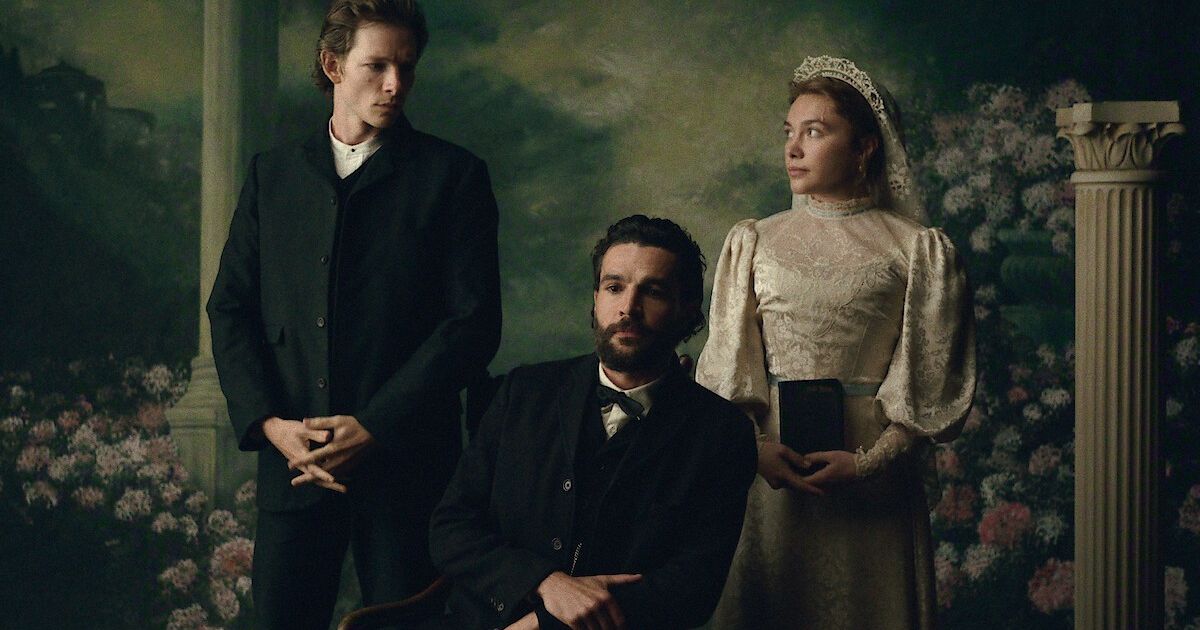
The writer and producer Zoe Kazan chose to return to John Steinbeck's novel East of Eden through a 7-episode series that has begun airing on Netflix, allowing the story of the Trask family to extend across generations and re-examine its characters and their contradictions.
Zoe says that the idea that drove her to adapt the novel became more urgent since she started working on it in 2020, which is the human capacity for change and carrying one's past without it becoming a burden that crushes them or something that loses its meaning.
During a virtual press conference for the work, dedicated to Golden Globe voters, which was attended by 'Afaq News', Kazan, who is involved in directing the series and is its writer and executive producer, along with Christopher Abbott, who plays Adam Trask, and Mike Faist, who portrays his brother Charles, spoke about character building and collaborating with Florence Pugh, who plays Cathy Ames and is also involved in executive production.
Kazan's connection to the novel began at the age of fifteen, before she knew of her grandfather, director Elia Kazan's connection to the film adapted from it. Growing up in California made the state's history evoked by the novel a source of curiosity, to the extent that her parents took her to Salinas after she read it, due to her deep attachment to the world of the book.
However, returning to the novel at different stages of her life revealed new meanings to her, as she said: 'This book is a puzzle for me; I have read it many times, and every time I return to it, I see something new.' After years, she dared to contact her agents, asking them to nominate her to write an adaptation if the rights became available, because she had a vision of what she wanted to do, and after about two years, the opportunity to present her project came.
The film Mayday recaptures the atmosphere of the Cold War through an adventure that combines action and comedy, but it places at its heart a human question about the image of the enemy.
Kazan saw that the television format is closer to the nature of the novel, which moves through time, has different chapters, and accumulates to create a meaning that transcends its parts. As for the 1955 film, she described it as iconic with its own voice, but it addressed only a part of the book and did not allow for the extended story that spans generations.
Kazan linked the relevance of the novel to resisting the tendency to confine people within final definitions and punishing them for their actions without allowing room for change. She says that the acknowledgment of 'I was wrong' carries great power, and she is grateful that she was able to reach this acknowledgment in her life.
She added: 'The idea that we are capable of change, and that we can carry our past without it being a stone heavier than our ability, and without it being something trivial and meaningless, is an idea that brings hope,' which is what she wishes for herself and her children, while seeing the conflict between brother and brother as a topic closely related to the present, despite its ancient roots.
This idea reflected in the choice of actors, as she saw in Bayo the ability to embody a masculine aspect within Kathy, who presents herself with overwhelming femininity, and sought for Adam a contrasting composition, through a presence that seems very masculine, hiding within it a different and more elusive nature.
The choice of Abbott, whom she has known for years and followed his work, was key in defining Charles, and afterwards, Faist became the first name she thought of for the role. She says that what she loves about actors is their ability to contain contradictions, which allows for the exploration of human complexity within the symbolic structure of the novel.
After its screening in Telluride, the film The Debut arrived at the Toronto Festival, bringing a new experience for actor, writer, and director Jesse Eisenberg, starring Julianne Moore and Paul Giamatti.
Abbott admitted that he was surprised when Kazan offered him the role, and he asked her if she wanted him for Charles or for Adam, wondering if he himself was limiting his potential to a certain pattern, but her explanation for the choice made the role more exciting for him, due to the layers, contradictions, and space it allowed for him to add his own details.
In response to a question from 'Horizon News' about the most complex aspects of Adam Trask when translating from page to screen, Abbott said that the character is filled with contradictions: Adam starts as a wandering young man living alone in the world, then as he ages, he becomes more conservative, perhaps even rigid in his beliefs.
He pointed out that Cathy is the main catalyst for his change, even if he doesn't realize it when it happens. He added that the complexity of the character expands performance options: 'You can play the game of opposites in almost every scene, and that's what I love, because it creates more sparks during filming.'
Abbot does not see Adam's inclination towards hope as a reduction of his character; his blind love for Cathy also carries darkness, and he goes through a deep period of sadness, which may lead to greater loss with age. Despite the goodness within him, he remains a flawed human being.
Abbot described the relationship between Adam and Charles as a combination of knowing the other and rejecting him, love and hate. He said, "There can be no hatred without love, otherwise it becomes mere indifference."
The half-brothers experience the effects of nature and nurture, and they follow paths that defy expectations: Charles, who seems more suited for war in his youth, stays at home, while Adam goes to war and lives a wandering life.
The first scene they shot together as adult brothers was their reunion after a long absence, and the training for it allowed them to explore what lies beyond words, even in a simple phrase like "You are burning the bacon," which carries broader meanings than the apparent action.
After five years of the experience that gave Apple its first victory of its kind at the Oscars, American director Sian Heder returns to collaborate with the company in the film Being Heumann.
As for Faist, he found his way into Charles through a person raised on the belief that evil is inherent in him. He wondered what this belief produces, and how jealousy and the pursuit of a parent's love can turn into violence, especially in a child who is unable to express his feelings.
Then comes the shame of violence, and the desperate desire for self-repair, and he says that the feeling of the character needing repair seemed to him both human and painful.
The story of the Hamilton family was the hardest part that Kazan had to condense. At first, she believed that the quote could not be accomplished without it, before the necessity of focusing on the Trask family became clear, as it is the backbone of the plot, and the characters of Daisy and Tom Hamilton remained dear to her, which is one of the reasons she invited the audience to read the novel.
The division of the episodes began spontaneously: after returning from a job in Australia, she arrived at the project presentation meeting and realized she had not divided the story into episodes, so she wrote a concept of eight episodes on a piece of paper she found in her father's car, before later shortening it to seven.
She wanted the episodes to follow a dialectical movement between the idea and its opposite and what results from them, and for each one to have its own character; she envisioned the first as a play by Arthur Miller, and the second close to Carrie or Days of Heaven.
The connecting thread was the concept of "Timshil," meaning "you may" or having the possibility of choice, and the characters' struggle with good and evil, while expanding aspects of my character and other characters who remained on the margins. As for Kieran Hinds, who embodies Samuel Hamilton, he was her first choice, and she recalled her old admiration for his character in Persuasion.
Kazaan rejected reducing Cathy in her initial presentation as a "monster," and pointed out that Steinbeck later revisits this description, questioning the meaning of judging her as evil without examining the reasons.
In order to respect this motivation, she wanted to move beyond some features of the text associated with the perspective of the white man in the mid-twentieth century, including racist descriptions and others that carry bias against women. She emphasized that she does not judge Steinbeck outside of his time, but seeks to liberate the humanistic tendency in the novel.
And it was Pugh who she wanted for Cathy, after seeing her in Midsommar, believing that she has the ability to understand the character and empathize with her without necessarily making her likable or justified.
Faist described working with her as a dream come true; she always kept him on his toes, like Abbott, despite the prior preparation. He said: "There was not a day I felt we were acting; everything felt alive."
Kazan recalled that an early draft turned the brothers' stance against their father, before reading the novel again revealed their true complexity, which is why she prefers to leave the characters to the audience without preconceived judgments, a sentiment that Faist agreed with: after research, preparation, and performance, the story becomes for the viewers, so they can interpret and reflect on it themselves.
Source: Ofoq News
Suggested
Read also
 Politics
Tripartite Meeting Between Egypt, Chad, and Libya Discusses Security in the Sahel and Sahara Region
 Politics
United States.. Woman Arrested on Suspicion of "Espionage for China"
 Politics