HMS Agamemnon.. Testing of Britain's Latest Nuclear Attack Submarine Begins
Britain is preparing to test its latest nuclear-powered and conventionally armed submarine, HMS Agamemnon, nicknamed Awesome Aggie, before it joins the Royal Navy and officially enters service.
Ofoq News
·4 minutes read
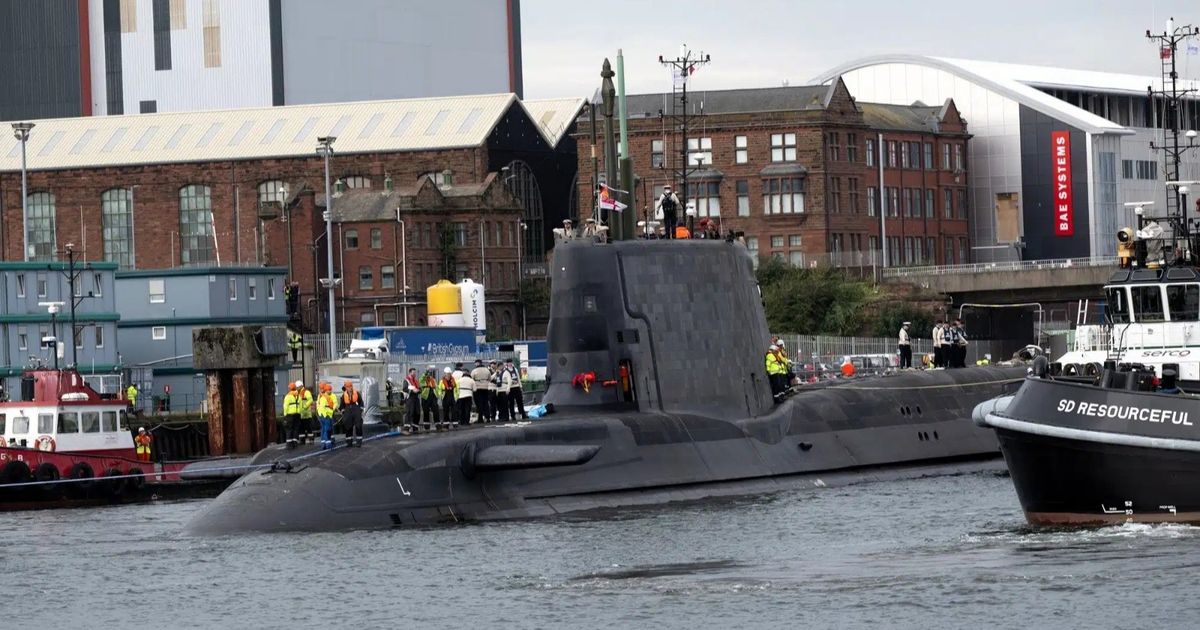
Britain is preparing to test the latest nuclear-powered submarine, the HMS Agamemnon, nicknamed Awesome Aggie, before it officially joins the Royal Navy and enters service.
The Astute-class submarines are the largest and most advanced attack submarines ever in the British Royal Navy, weighing 7,400 tons and measuring 97 meters in length, which is approximately the length of two Olympic swimming pools, according to Naval News.
These submarines operate with a nuclear reactor produced by Rolls-Royce, manufactured in Derby in the Midlands, and will not require refueling throughout their service life.
The submarine's high technical capabilities include stealthy precision strikes, anti-submarine warfare, and intelligence gathering.
The HMS Agamemnon will be armed with heavy Spearfish torpedoes and Tomahawk IV land-attack missiles, capable of striking targets over 1,000 miles away.
In addition to its role in supporting ongoing deterrence at sea, Astute-class submarines also participate in protecting naval task groups and providing support for UK and NATO operations.
British Prime Minister Andy Burnham said: "Having seen for myself the dedication and pride of the workforce at Barrow shipyard in building submarines, and the dedication and pride of the thousands of people working in our submarine supply chain in the UK, I know how important this achievement is for each and every one of them."
He added: "As one of the most advanced submarines ever, HMS Agamemnon will play a key role in enhancing our security here at home and across NATO."
British Defence Secretary Wes Streeting confirmed that "deterrence is the cornerstone of our national security, and sending another powerful attack submarine to sea enhances that deterrence and shows how we are preparing to face the threats of a more dangerous world."
The head of the UK Ministry of Defence's nuclear defense division, Maddy McTiernan, noted that "conducting sea trials for HMS Agamemnon represents an important moment for the UK's nuclear defense establishment, and is clear evidence of the engineering and industrial excellence of the workforce in Barrow and across the wider supply chain in the UK."
The First Sea Lord, Admiral Sir Gwyn Jenkins, said: "In an increasingly dangerous world, naval power remains essential to safeguarding our nation and our people. Our submarine fleet is vital to this endeavor, and I am pleased that HMS Agamemnon, the sixth of our Astute-class submarines, has begun her sea trials and will soon arrive at Her Majesty's Naval Base Clyde to join the fleet."]
He added: "As we continue to enhance our combat readiness, HMS Agamemnon will play a pivotal role in maintaining the security of the United Kingdom, contributing to NATO's collective defense, and ensuring our preparedness to lead, fight, and win."
Today, great powers are competing to develop nuclear submarines capable of diving for decades. The report reveals how they operate and what their real dangers are. It also tells the story of the explosion of the Russian submarine Kursk.
He explained that "based on the commitments related to the continuous production of submarines pledged in the 2025 Strategic Defense Review, which has been reinforced in the Defense Investment Plan, the completion of HMS Agamemnon's construction demonstrates the strength and reliability of British industry and its world-leading nuclear technology."
The Defense Investment Program is supported by a financial commitment of £298 billion (approximately $395 billion) over the next four years, including £47 billion (approximately $62 billion) for investment in submarine construction programs, which also includes maintenance and infrastructure.
A portion of this spending will enable the United Kingdom to produce a submarine every 18 months to support the SSN-AUKUS program.
Submarine-launched ballistic missiles are among the most difficult weapons to intercept, as they can be launched from the depths of the seas from almost anywhere around the world.
The UK Ministry of Defence's nuclear spending contributes to the significant growth and expansion in Barrow, enhancing the economic stability resulting from the government's commitment to the submarine building program, the Barrow Decadal Plan, supported by the £200 million Barrow Transformation Fund (approximately $265 million), and the defense nuclear work supports over 14,000 jobs at the Barrow-in-Furness shipyard.
The submarine HMS Agamemnon was delivered as part of a national effort by the UK Ministry of Defence's Nuclear Deterrent Authority, a partnership organization responsible for operating, maintaining, renewing, and supporting the UK's nuclear deterrent capabilities.
The HMS Agamemnon was officially launched by King Charles III at a ceremony held on September 22, 2025.
The seventh and final submarine of this class, Achilles, has reached advanced stages of construction at Barrow dock, and will replace the Astute class with up to 12 new SSN-AUKUS nuclear attack submarines starting from the late next decade.
The steel cutting for the first submarine of this class is scheduled to begin at Barrow dock next year, which enhances the city's pivotal role in delivering AUKUS submarines.
Source: Ofoq News
Suggested
Read also
 Politics
Tripartite Meeting Between Egypt, Chad, and Libya Discusses Security in the Sahel and Sahara Region
 Politics
United States.. Woman Arrested on Suspicion of "Espionage for China"
 Politics