Nuclear Reactor and Electromagnetic Gun.. China Outlines the Future Tank
Defense researchers in China have prepared a long-term plan for an electric tank weighing 60 tons, powered by a small nuclear reactor, and equipped with a 50-megajoule electromagnetic gun.
Ofoq News
·4 minutes read
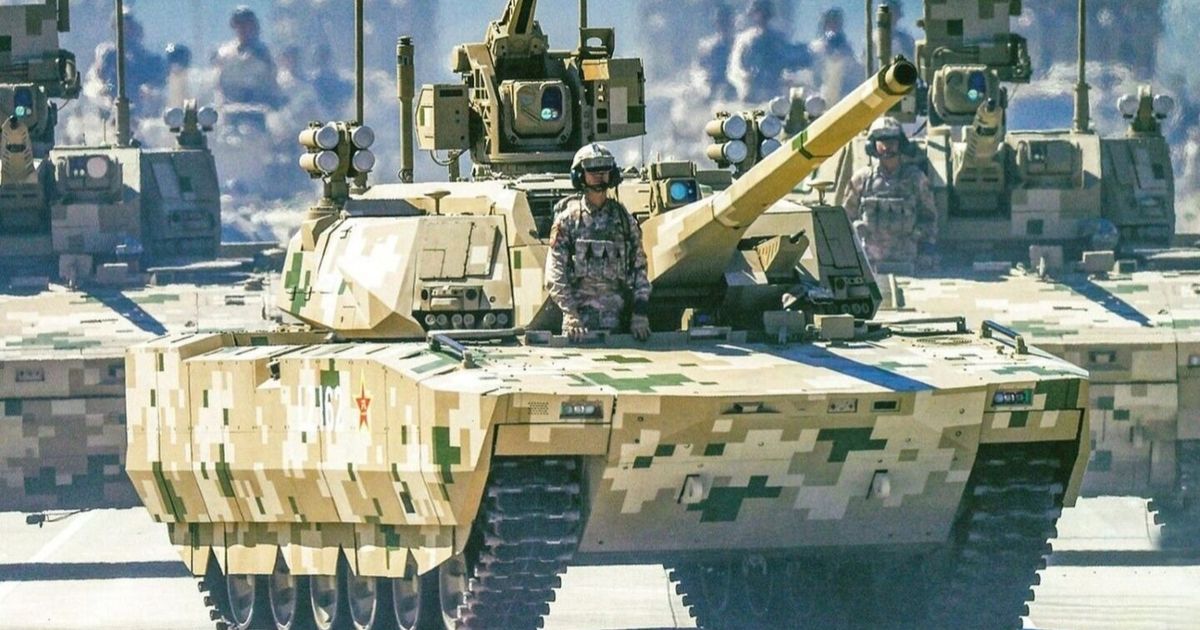
Chinese defense researchers have prepared a long-term plan for an electric tank weighing 60 tons, powered by a small nuclear reactor, and equipped with a 50-megajoule electromagnetic cannon.
The development path is expected to continue beyond 2045, according to "Military Watch" magazine.
The study was conducted by researchers from the Inner Mongolia First Machinery Group, the government’s key laboratory for the design and manufacture of special vehicles, and Beijing Institute of Technology, and was published in a research paper in the June 2026 supplement of the Chinese journal Acta Armamentarii, which specializes in defense affairs.
The Inner Mongolia First Machinery Group is part of the Chinese defense industry sector and plays a prominent role in the development and production of armored vehicles.
The European company KNDS, specialized in manufacturing armored vehicles, has unveiled a new concept for a main battle tank aimed at the French armed forces and their European allies.
Researchers propose a 3-phase path for tank development; the first phase, targeted before 2035, involves equipping current armored vehicle platforms with electromagnetic weapons while retaining traditional diesel engines.
A proposed 1500 horsepower diesel generator will be integrated with supercapacitors and a flywheel energy storage system to provide the high instantaneous power required for the electromagnetic weapon.
The first-generation system will feature a 10-megajoule electromagnetic cannon.
Researchers estimate the theoretical range of this weapon to be about 150 kilometers.
The vehicle is expected to include an electromagnetic armor system in its first phase, requiring about 2 megajoules of energy. This design aims to enable the development and testing of this technology without the need for the more complex nuclear power station designed for the final configuration.
As for the second phase, which extends until 2045, it will increase the energy of the electromagnetic cannon to about 20 megajoules, with a proposed range of about 300 kilometers.
The electromagnetic shield will also become significantly stronger, as the system is expected to consume 10 megajoules of energy, and a 2000-horsepower diesel generator will provide the electrical power, supported by about 5 tons of advanced energy storage equipment.
Nuclear energy will be introduced in the final phase, where researchers envision a small standard reactor with a capacity of 10 megawatts, using liquid metal cooling, and the reactor system will be designed to fit a volume of approximately 2 cubic meters.
The vehicle will use the reactor to provide the large and sustainable electrical power needed for the electromagnetic weapon and other systems on board.
In this phase, the proposed energy for launching the electromagnetic cannon will reach about 50 megajoules.
Researchers link the speed of a weapon projectile to about 3.5 kilometers per second, with a theoretical maximum range of about 450 kilometers.
This weapon will have a much greater range than conventional tank guns, and will shift the main armament of the vehicle towards a role that combines the characteristics of direct-fire armor and long-range precision fire.
The proposed design focuses on meeting the increasing electrical power needs of future armored vehicles.
Instead of considering the nuclear-powered vehicle as an immediately executable program, researchers are studying how to gradually integrate advanced weapons, electromagnetic protection systems, and other electrical equipment as power generation and storage technologies evolve.
The study places great emphasis on the development of integrated power systems, as supercapacitors, flywheels, advanced batteries, superconducting storage units, and integrated microgrid power networks for vehicles are technologies considered potential solutions for providing the high instantaneous power required by future weapons.
This research paper highlights the increasing confidence of experts in the Chinese defense sector, as Beijing introduced the world's first fourth-generation main battle tank, the Type 100, into service last year, advancing several years ahead of the rest of the world.
China showcased its next-generation tank, the Type 100, also known locally as ZTZ-100, in training footage on Monday, indicating its likely entry into actual service.
China maintains a prominent lead in its aircraft capabilities, and it is expected to be nearly a decade ahead of the world in introducing sixth-generation fighter jets into service.
Although a nuclear-powered tank is expected to be technically feasible, its economic viability remains a serious question, especially with the increasing reliance on ground warfare using large numbers of low-cost unmanned systems instead of high-value heavy armored assets.
As demonstrated in the Russian invasion of Ukraine, the firepower of main battle tanks was of secondary importance, while the ability to communicate with drones, maintain mobility, and utilize advanced active protection systems were paramount, all of which are capabilities that the Type 100 prioritizes.
Source: Ofoq News
Suggested
Read also
 Politics
Tripartite Meeting Between Egypt, Chad, and Libya Discusses Security in the Sahel and Sahara Region
 Politics
United States.. Woman Arrested on Suspicion of "Espionage for China"
 Politics